





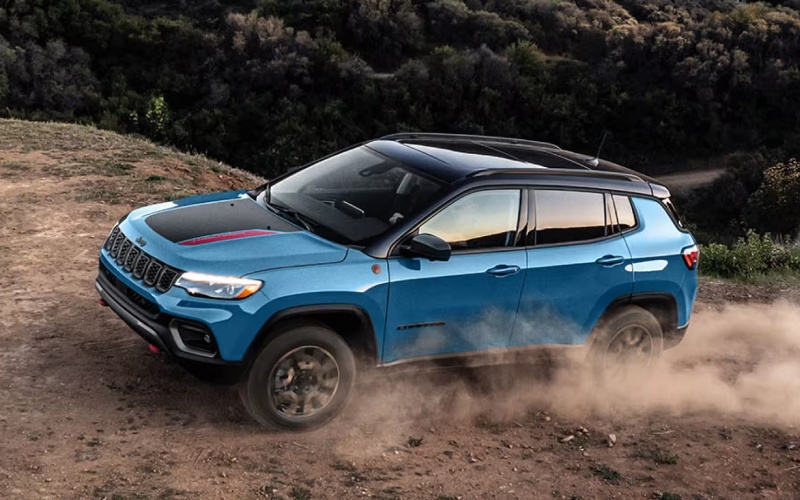
James CDJR of Cedar Lake - Which SUV offers better all-weather traction for Dyer, IN drivers — the 2026 Jeep Compass or the 2026 Honda CR-V?
All-weather confidence is one of the most common questions we hear from compact SUV shoppers: which platform puts more traction tech to work when conditions get messy? The Compass arrives with standard AWD on every trim, and Trailhawk adds a specialized calibration with Selec-Terrain, including a Rock mode that’s designed to manage throttle, braking, and torque distribution over uneven surfaces. The CR-V counters with Real Time AWD™ that smartly routes torque to the rear when fronts slip, a setup that shines in rain and snow and supports stable, predictable handling on paved roads. But the distinctions in hardware and drive modes help the Jeep feel more composed when surfaces change quickly—think slush to gravel to packed snow—because the system is primed for traction rather than reacting after the fact.
For Dyer, IN commuters who encounter plows, freeze-thaw potholes, and the occasional unplowed parking lane, the question often becomes how much control you want at your fingertips. The Compass pairs its standard AWD with a geared 8-speed automatic, which gives you tangible control over engine braking on slick downhills, crisp downshifts before a pass, and steady throttle transitions when you need to roll into the power gently. The CR-V’s CVT and hybrid e-CVT emphasize smoothness and efficiency rather than that direct, mechanical feel. And when traction management meets towing, the Compass’s available 2,000-pound rating offers a useful margin over the CR-V’s lighter-duty capacity for small trailers or cargo carriers you might use year-round.
- AWD coverage: Compass includes AWD standard on every trim; CR-V offers AWD standard on select trims and available on others.
- Drive modes: Compass Selec-Terrain adds Snow, Sand/Mud, and a Trailhawk-only Rock mode; CR-V offers user-friendly modes focused on on-road confidence.
- Camera tech: Compass offers an available 360-degree Surround View Camera for low-speed awareness; CR-V does not offer a surround-view system.
- Transmission feel: Compass uses a responsive 8-speed automatic; CR-V employs a CVT or e-CVT tuned for smoothness over engagement.
- Towing headroom: Compass is rated up to 2,000 pounds when properly equipped; CR-V’s max rating is lower, which can limit utility.
These differences add up in practical ways. On a slick morning start, the Compass’s traction strategy and conventional gearing make it easy to modulate power and keep momentum without spinning a wheel. Crest a plowed berm into a side street, and the available surround-view camera eases navigation around hidden curbs and snow piles. Transition to a wet gravel pull-off near a trailhead, and Selec-Terrain helps keep the driveline composed as surfaces change under load. The CR-V is undeniably confident on-road and in light snow, but it does not match the Jeep’s toolset when traction and surface variety are the primary concerns.
If you are cross-shopping, consider your daily scenarios: unplowed subdivision turns, angled driveways after a freeze, or muddy fields during spring sports. Do you want a system that anticipates grip changes, or one optimized for paved stability first? One approach is not “better” for everyone, but the Compass structure favors drivers who regularly mix surfaces and want direct control through a geared automatic and robust traction programming.
At the end of the day, your best answer will come behind the wheel. Bring your most relevant routes to a test drive and ask for a demonstration of traction modes, camera views, and downhill control. James CDJR of Cedar Lake will happily tailor a drive loop that mirrors your real-world conditions, serving Crown Point, Dyer, and St. John with expertise that focuses on how you actually drive, not just spec sheets. You will feel the differences where they matter most—at your fingertips and through the seat of your pants—when weather shows up uninvited.
Frequently Asked Questions:
Does the Compass’s Rock mode help on plowed-but-rutted side streets?
Rock mode is tuned for uneven, low-traction surfaces, managing wheel spin and torque delivery to maintain momentum. While you will not use it every day, it can help the driveline stay composed when ruts, ice patches, and mixed slush try to upset traction at low speeds.
How valuable is a 360-degree camera in winter?
Very. Snowbanks and slush piles can hide curbs and debris. A surround-view system gives you a bird’s-eye perspective that can prevent tire and wheel damage and reduce stress in tight, obscured spaces.
Is Real Time AWD™ enough for typical Midwest winters?
For many drivers, yes—especially if your routes are primarily plowed suburban and highway miles. If your routine includes unplowed lots, gravel connectors, or frequent elevation changes on slick surfaces, the Jeep’s traction modes and 8-speed automatic deliver added control and confidence.
Request more 2026 Jeep Compass information
Categories:
Jeep Compass